
How to Care for Dental Implants Every Day?
At Jupiter Smile Hub, we have helped many patients regain their confidence and oral health with top-of-the-line restorative treatments. Another thing we always highlight is that long-term success is not just about the procedure but the patient's daily care of the new smile as well. Good oral care, healthy lifestyle choices, and routine checkups all contribute to a long-lasting implant.
Think of this guide as a practical reference for the habits that protect your implant after the initial healing period and for the daily choices that count more than most patients expect.
What Daily Implant Care Actually Involves
Unlike what many people think, taking care of a dental implant is not much more difficult than taking care of a natural tooth and is less complicated than the care of a medical device. The titanium root is bonded to your jawbone, and the crown on top is treated just like any other tooth, but with a little extra care around the gum line.
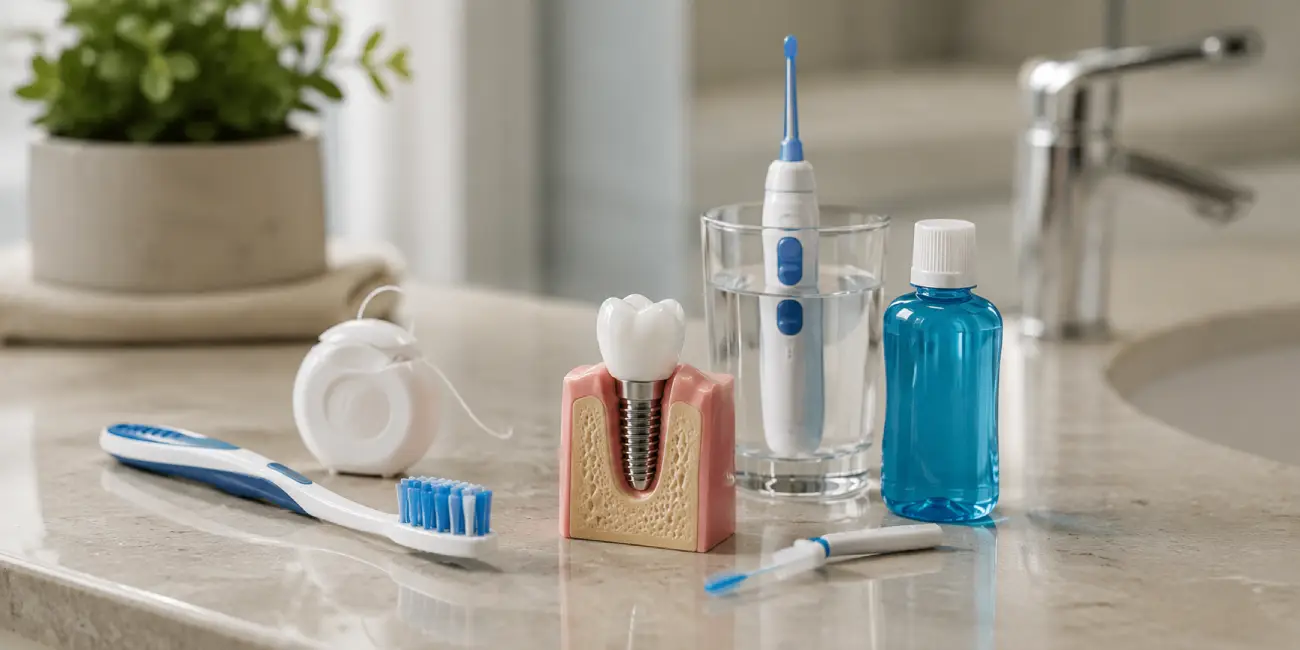
- Brush twice a day with a soft-bristle or electric brush, focusing on where the crown meets the gum.
- Floss once a day with implant-safe floss or an interdental brush that won't damage the surface.
- A water flosser helps if you have a bridge or several implants close together.
- An alcohol-free mouthwash may support your routine when recommended by your dentist, but it should not replace brushing or interdental cleaning.
- During healing, avoid hard and sticky foods that could disrupt the implant area. After healing, do not use the restoration to break ice, bite pens, or open packaging.
Building the Habit After Surgery
Single implants, bridges, and full arch restoration require a slightly different approach to cleaning, but the basics remain the same. For example, a gap under a bridge that a toothbrush can't reach is as important as the habit itself because of the tools you use. After the first few weeks, most patients get into a working routine.
- Single tooth implants respond well to the same brushing and flossing technique used on natural teeth nearby.
- Interdental brushes or a water flosser should be used for bridges and multi-unit restorations to remove food particles that get stuck underneath the restoration.
- Full-arch restorations benefit from a fixed daily sequence, since missing a spot is easy when several implants sit close together.
- The first three months are worth treating as a training period, since that is when the new routine becomes automatic.
Think of this guide as a practical reference for the habits that protect your implant after the initial healing period and for the daily choices that count more than most patients expect.
Why Daily Care Deserves Your Attention
Patients usually question the need for such meticulous care if an artificial tooth cannot get cavities. The reality is that it can still cause damage to the surrounding tissue, and the overall health of the gums and bone around the implant can affect its long-term stability and functionality. Daily care is not a task but a form of protection.
- When the gum inflammation doesn't have the chance to begin, comfort improves.
- The savings add up because the cost of replacing a failed implant is much higher than the cost of a replacement toothbrush head.
- Confidence stays intact because a healthy implant looks and feels indistinguishable from a natural tooth.
- Your other teeth benefit too, since a well-maintained implant does not shift bite pressure onto them.
Patients considering dental implants in Dubai should understand that the daily routine is simple, but it plays an important role in protecting the gums, bone, and restoration over time.
What We Observe Over Time
The differences we observe between patients over time are often influenced by daily hygiene, lifestyle habits, bite forces, and attendance at follow-up appointments, rather than the surgery itself. By monitoring regularly, we can identify small changes before they become significant changes.
- Daily hygiene habits set the baseline for how the surrounding tissue responds over months and years.
- Lifestyle factors such as smoking or grinding can offset even a strong home care routine.
- Bite forces and how the implant is loaded affect wear on the crown and connecting components.
- Going to follow-up appointments helps identify small problems before they get worse.
Problems We See When Care Slips
Most complications we treat share a common root cause: a gap somewhere in the daily routine. Peri-implantitis, the inflammatory condition that threatens implant stability, rarely appears overnight. It builds slowly, usually starting with plaque that goes unnoticed along the gum line. Good daily care, regular monitoring, and timely gum treatments when needed can help reduce the risk and protect the long-term health of your dental implants.
- Bleeding gums around an implant usually signal early inflammation, not a serious problem yet.
- Bad breath that will not go away often points to trapped bacteria beneath a bridge or crown.
- A loose-feeling crown needs prompt attention rather than a wait-and-see approach.
- Bone loss visible on an X-ray is a later-stage change that daily care and monitoring help guard against.
- Smoking and untreated grinding can accelerate these issues faster than people expect.
Addressing Problems Early
Often, grinding, smoking, and lack of checkups occur together in the cases we are most concerned about, but not all three factors indicate a problem. If inflammation is caught early, professional cleaning, better home care, or additional treatment might be able to help keep it under control and prevent further damage.
- Book a review as soon as you notice bleeding, discomfort, or a change in how the crown feels.
- Mention grinding or clenching to your dentist, since a night guard can reduce pressure on the implant.
- Keep to the recommended checkup interval even when everything feels normal, since early changes are not always noticeable at home.
- Ask about imaging if a checkup reveals any uncertainty about the bone level around the implant.
Anyone researching dental implants in Dubai should become familiar with these warning signs before treatment, as knowing what to expect can make the experience feel clearer and less intimidating.
Give Your Restored Smile the Support It Deserves
Dental implants should be something that eventually becomes part of your daily routine. The ideal situation, after all, is not thinking about your dental implant all the time, but knowing that your gums, bite, and dental implants are healthy.
At Jupiter Smile Hub, we use review appointments to assess how the implant is settling, whether the bite feels balanced, and whether any small changes need attention. This gives patients reassurance without repeating the same general advice at every visit.
If you are looking for dental implant treatment in Dubai, remember that aftercare begins with choosing a clinic that explains the process clearly and remains available throughout recovery.
A restored smile deserves the same attention as the decision that created it. For patients looking for dental implants in Karama, our location above Ansar Gallery makes consultations and follow-up visits convenient. Book a consultation with Jupiter Smile Hub to discuss your options, ask questions, and understand what long-term implant care would look like for you.
Considering dental implants in Dubai? Contact us today to book your consultation at Jupiter Smile Hub and learn how our personalized treatment and aftercare can help protect your smile for years to come.